
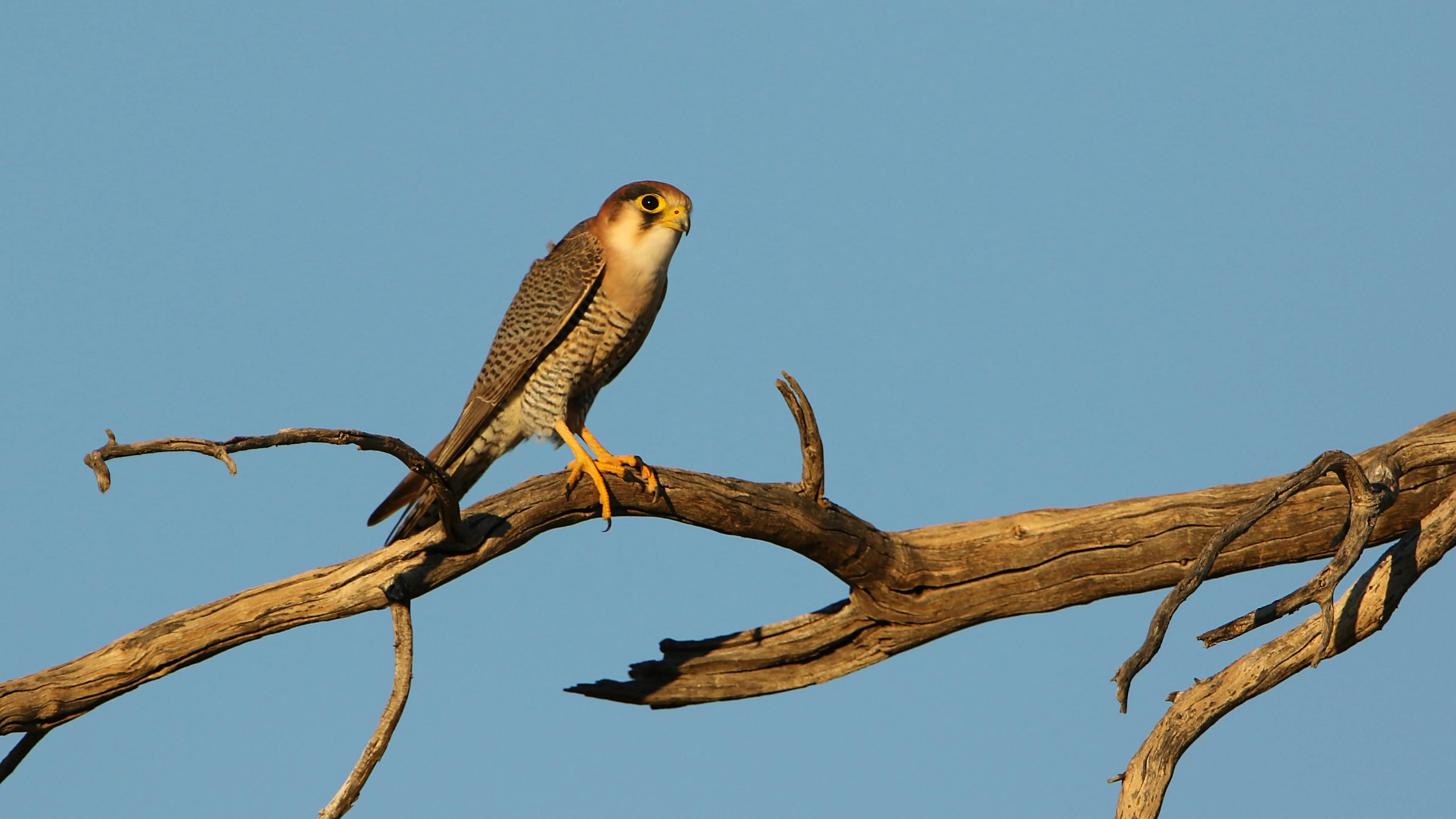
Red-necked Falcon
Red-necked Falcon
The Red-necked Falcon: A Master of the Skies in the Avian World. Birding Safari
Introduction
The Red-necked Falcon (Falco chicquera) is a striking bird of prey that commands attention with its vibrant plumage, agile flight, and predatory prowess. Found across parts of the Indian subcontinent and sub-Saharan Africa, this raptor is both a marvel of evolution and a crucial component of its ecosystem. This comprehensive guide delves into the biology, behavior, habitat, and conservation of the red-necked falcon.
Taxonomy and Classification
The red-necked falcon belongs to the family Falconidae, a group known for their speed, sharp talons, and keen eyesight. It is closely related to other members of the Falco genus, such as the peregrine falcon and merlin.
Scientific Classification:
- Kingdom: Animalia
- Phylum: Chordata
- Class: Aves
- Order: Falconiformes
- Family: Falconidae
- Genus: Falco
- Species: F. chicquera
There are two recognized subspecies:
- Falco chicquera chicquera – Found in the Indian subcontinent
- Falco chicquera ruficollis – Native to Africa
Physical Characteristics
The red-necked falcon is a medium-sized raptor, easily identifiable by its unique coloration and streamlined body.
Key Features:
- Size: 30–36 cm in length
- Wingspan: 70–85 cm
- Weight: 200–300 grams
- Coloration:
- Rusty-red nape and neck
- Bluish-grey upperparts
- White underparts with fine black barring
- Distinctive black moustachial stripe
Its long wings and tail make it an agile flier, capable of swift, acrobatic maneuvers during a hunt.
Habitat and Distribution
The red-necked falcon thrives in a variety of habitats, showcasing its adaptability and resilience.
Preferred Habitats:
- Open woodlands
- Grasslands
- Agricultural fields
- Semi-arid regions
- Urban outskirts
Geographic Range:
- Africa: From Senegal and Sudan to South Africa
- Asia: Predominantly in India, Sri Lanka, and parts of Pakistan
This falcon prefers areas with scattered trees or tall structures, which it uses as perches for hunting and nesting.
Hunting Techniques and Diet
The red-necked falcon is a diurnal hunter, relying on its exceptional vision and speed to capture prey.
Hunting Strategies:
- Aerial Pursuit: Chases birds mid-flight with astonishing agility
- Perch-and-Pounce: Waits on a high perch before swooping down
- Cooperative Hunting: Pairs may hunt together, especially during breeding season
Diet:
- Small birds (e.g., sparrows, doves, mynas)
- Large insects (e.g., grasshoppers, beetles)
- Occasionally small mammals and reptiles
Its diet varies based on availability, but birds make up the majority of its intake.
Breeding Behavior and Lifecycle
The red-necked falcon exhibits fascinating reproductive behavior, often forming monogamous pairs that last for life.
Breeding Season:
- India: December to April
- Africa: Varies by region, often linked to rainfall
Nesting:
- Typically uses old nests of crows or other raptors
- Nests are located on tall trees, cliffs, or man-made structures
- No nesting material is added
Lifecycle:
- Clutch Size: 3–4 eggs
- Incubation Period: 28–30 days
- Fledging: Chicks fledge at around 5 weeks
- Parental Care: Both parents feed and protect the young
Conservation Status and Threats
While currently listed as Least Concern by the IUCN, the red-necked falcon faces several threats that could impact its population over time.
Major Threats:
- Habitat Loss: Due to deforestation and urban expansion
- Pesticide Use: Reduces prey availability and causes poisoning
- Persecution: Sometimes hunted or trapped illegally
- Electrocution: Collisions with power lines
Conservation Efforts:
- Protected under various national wildlife acts
- Habitat preservation and awareness campaigns
- Monitoring of population trends
Cultural Significance
In many regions, the red-necked falcon is admired for its grace and hunting skill. In parts of India, it has been associated with royalty and falconry traditions.
Historical and Cultural Notes:
- Featured in ancient Indian art and literature
- Used in traditional falconry in some African cultures
- Symbolizes agility and precision in local folklore
How to Spot a Red-necked Falcon
Birdwatchers and wildlife photographers often seek out this elusive raptor for its beauty and behavior.
Tips for Spotting:
- Visit open habitats during early morning or late afternoon
- Look for pairs perched on tall trees or electric poles
- Listen for their sharp, repeated calls: “kek-kek-kek”
Best Locations:
- India: Rajasthan, Gujarat, Karnataka
- Africa: Botswana, Kenya, Namibia
Bring binoculars and a field guide to enhance your observation experience.
Interesting Facts
- The red-necked falcon can reach speeds of up to 160 km/h during a dive.
- It often hunts in pairs, coordinating attacks to flush and catch prey.
- Despite its name, the “red neck” is more of a rusty-orange hue.
- It does not build its own nest but reuses those of other birds.
- Its population is stable, but localized declines have been noted in urbanized areas.
FAQs
1. What is the scientific name of the red-necked falcon?
The red-necked falcon is scientifically known as Falco chicquera.
2. Where can I find the red-necked falcon?
It is found across India, Sri Lanka, and parts of sub-Saharan Africa, especially in open woodlands and grasslands.
3. What do red-necked falcons eat?
Their diet primarily consists of small birds, large insects, and occasionally small mammals.
4. Is the red-necked falcon endangered?
No, it is currently listed as Least Concern by the IUCN, but local threats could impact its future.
5. How can I help conserve the red-necked falcon?
Support wildlife conservation efforts, avoid using harmful pesticides, and spread awareness about raptor protection.
Conclusion
The red-necked falcon is a testament to nature’s elegance and efficiency. With its vivid plumage, remarkable hunting skills, and ecological importance, it deserves not only admiration but also protection. As habitats shrink and threats mount, understanding and appreciating this raptor becomes more vital than ever. Whether you’re a seasoned ornithologist or a casual birdwatcher, the red-necked falcon offers an inspiring glimpse into the wild world of avian predators.