
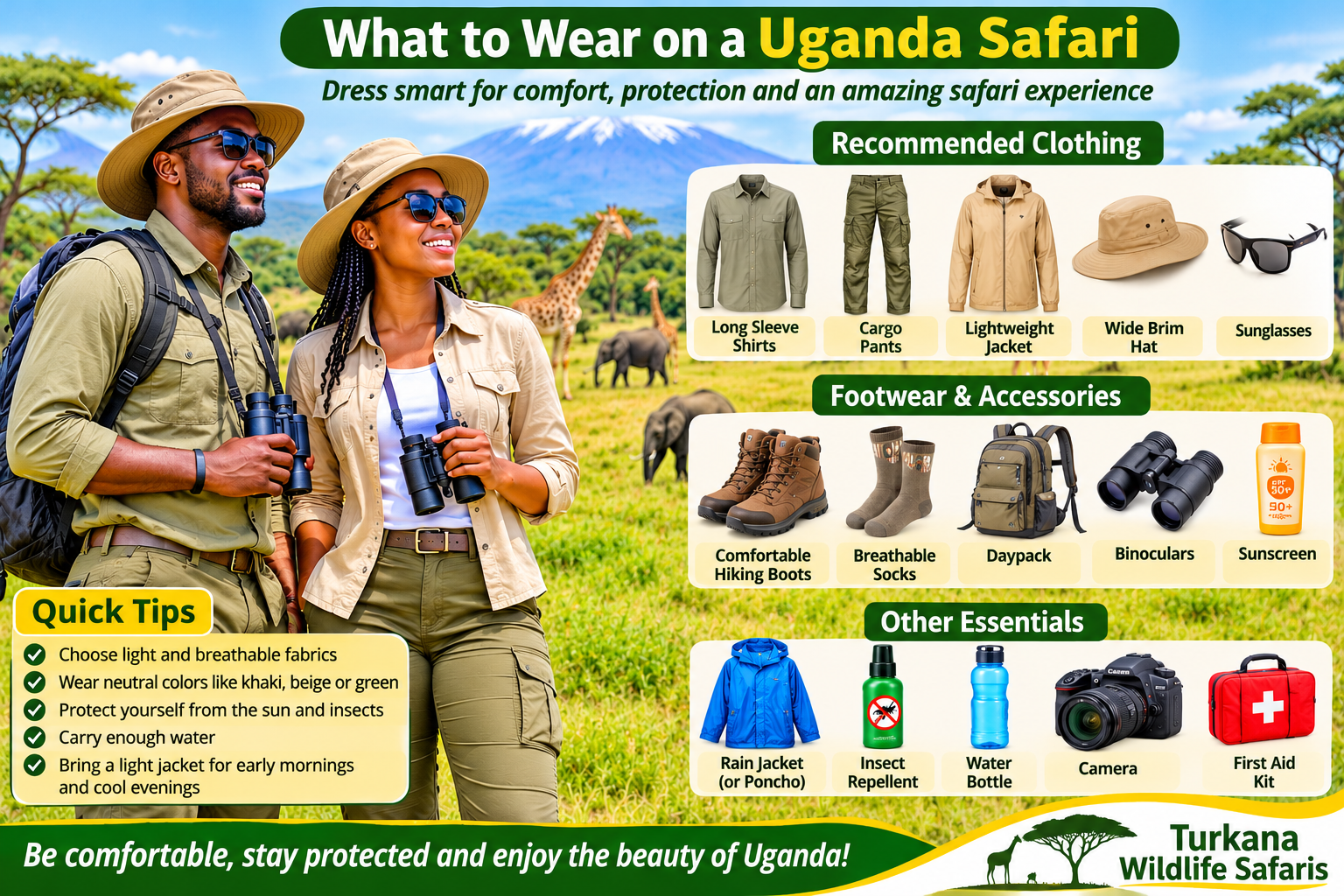
What to Wear on a Uganda Safari
What to Wear on a Uganda Safari
What to Wear on a Uganda Safari: The Complete Packing Guide
Introduction
A Uganda safari is unlike any other wildlife experience. In a single day, you can move from the cool, misty trails of Bwindi Impenetrable Forest to the sunbaked savannah of Queen Elizabeth National Park, where temperatures can swing from a chilly 10°C at dawn to a warm 30°C by afternoon. Getting your clothing and gear right is not just about comfort. It directly affects how close you can get to wildlife, how well you are protected from insects, and whether you stay dry when a tropical shower appears without warning.
This guide from Turkana Wildlife Safaris Uganda breaks down exactly what to wear and pack for a Ugandan safari, from colour rules and layering systems to footwear and trekking gear. Whether you are tracking mountain gorillas, chimpanzees, or simply enjoying game drives across the Pearl of Africa, this is the practical packing advice you need before you zip up your duffel bag.
Why Packing Correctly for Uganda Matters
Uganda’s climate is not uniform. The country sits on the equator but rises to over 2,000 metres in the southwest, creating dramatically different conditions within short distances. Pack only for heat and you will shiver through a dawn game drive. Pack only for cold and you will overheat on the open savannah. The golden rule of Uganda safari packing is simple: neutral colours, smart layers, and waterproof everything.
Packing the wrong clothing also has consequences beyond comfort. Dark blue and black fabrics attract tsetse flies, whose bite is painful and can transmit disease. Bright white and neon colours startle wildlife at close range, reducing the quality of your sightings. Military-style camouflage is restricted for civilians in Uganda and can cause problems at park entrances and borders. Getting the basics right protects both you and the wildlife experience you came for.
The Colour Rule: What to Wear and What to Avoid
Colour is the single most important decision in your safari wardrobe. It is not about fashion. It is about function.
Colours That Work
Khaki, olive, tan, beige, stone grey, and muted brown are the gold standard for safari clothing. These earth tones blend into both dry savannah and green forest, keep you inconspicuous to animals, and hide the red dust that coats everything on Ugandan roads. Olive and soft green are especially effective in the rainforests of Bwindi and Kibale, where they mirror the dense vegetation. You can see these environments in action on a Bwindi gorilla trekking tour.
Colours to Leave at Home
| Colour | Why to Avoid It |
|---|---|
| Dark blue and black | Strongly attracts tsetse flies, which key in on dark colours that mimic large animal hides |
| Bright white | Stands out sharply in the bush, startles wildlife, and shows every speck of dust |
| Neon, red, orange, yellow | Makes you the most visible object in the landscape and can cause animals to retreat before you get a good look |
| Camouflage print | Restricted for civilians in Uganda and reserved for military use |
Save the colourful clothing for lodge dinners. On game drives, forest walks, and treks, stick to neutrals.
Layering: Your Best Defence Against Uganda’s Swinging Temperatures
Uganda’s safari days often begin before sunrise, when the air in high-altitude parks like Bwindi and Mgahinga can sit in single digits Celsius. By midday, the same location may feel like a different season entirely. A layering system lets you adapt without carrying a heavy wardrobe.
Base Layer
Start with a lightweight, moisture-wicking long-sleeved shirt in a neutral colour. Long sleeves are non-negotiable for daytime activities: they shield your arms from the equatorial sun, block mosquito bites, and protect against stinging nettles and thorny undergrowth on forest trails. Merino wool or synthetic fabrics are far superior to cotton, which absorbs sweat and dries slowly.
Mid Layer
Pack a fleece, lightweight down jacket, or softshell pullover for early morning game drives and cool evenings at lodges. Even at the equator, altitude drops the temperature quickly once the sun goes down, and a second layer is often welcome after dark.
Outer Layer
A waterproof rain jacket or poncho is essential year-round. Uganda’s tropical showers can arrive with little warning, even outside the official rainy seasons of March to May and October to November. A lightweight, packable shell that fits over your layers is more practical than a heavy coat.
Essential Clothing Checklist
Based on guidance from Turkana Wildlife Safaris Uganda’s own packing guide and other field-tested sources, here is a practical clothing list for a typical safari of seven to ten days with lodge laundry available:
-
3 to 4 long-sleeved shirts in neutral colours (sun and insect protection)
-
2 to 3 lightweight long trousers (quick-dry fabrics; zip-off convertible trousers are genuinely useful)
-
2 to 3 short-sleeved shirts or T-shirts for warm afternoons and lodge evenings
-
1 to 2 pairs of shorts for lodge time only (not for trekking)
-
1 fleece or warm mid-layer
-
1 waterproof rain jacket
-
1 wide-brimmed hat (sun protection for game drives and savannah walks)
-
1 beanie or warm hat (for cold high-altitude mornings in Bwindi)
-
1 scarf or buff (dust protection on murram roads)
-
Underwear and socks for your laundry schedule; wool-blend hiking socks help prevent blisters
-
1 swimsuit if your lodge has a pool or you plan to relax at Lake Bunyonyi
Heavy denim jeans are best left at home: they are slow to dry, heavy, and cold when wet, the opposite of what you want in a rainforest.
Footwear: Where Most Safari Travellers Go Wrong
Footwear is the item most often underestimated, and the one that can make or break a gorilla trek. Uganda’s forest trails in Bwindi and Mgahinga are steep, muddy, and often slick with rain. The right boots are not a luxury. They are essential safety gear.
Hiking Boots
Choose waterproof, ankle-high hiking boots with deep tread and good grip. Break them in for at least two to four weeks before your trip to avoid blisters on the trail. Brands like Merrell, Keen, Salomon, and Lowa are commonly recommended for safari use. Trail runners and sneakers do not provide enough ankle support or traction for Bwindi’s mud. You can read more about what to expect on the trail in the Bwindi gorilla trekking guide.
Lodge and Travel Shoes
Bring a pair of comfortable sneakers or trainers for travel days and lodge use, and a pair of light sandals or flip-flops for relaxing at camp. These take up little space and make a big difference to your comfort after a long trek.
Trekking Extras
For gorilla and chimpanzee trekking, consider gaiters to keep mud and ants out of your boots, and gardening gloves to protect your hands when grabbing vines and branches on steep slopes. Tuck your trousers into your socks or gaiters. This simple step keeps safari ants and other biting insects away from your skin.
Safari Gear and Optics
The right gear turns a good safari into an unforgettable one. These are the items experienced Uganda travellers consistently recommend:
-
Binoculars: A decent pair (8×42 or 10×42 is a versatile all-round choice) transforms distant shapes into identifiable animals and is invaluable for birding.
-
Camera with spare batteries and memory cards: Dust on Ugandan roads finds its way into everything, so bring cleaning cloths and a waterproof bag or dry sack.
-
Power bank: Long transfer days between parks can run eight to nine hours, and a backup charger keeps your camera and phone alive.
-
Headlamp or flashlight: Many lodges have limited night-time lighting, and a red-light mode is useful for night wildlife viewing without disturbing animals.
-
Reusable water bottle: Staying hydrated is critical, especially on hot savannah afternoons.
-
Small daypack: For water, snacks, camera, rain cover, and an extra layer on daily excursions.
Health and Personal Care Essentials
Uganda is a tropical destination, and a little preparation goes a long way:
-
Insect repellent with DEET or picaridin: Reapply through the day, not just at dawn and dusk.
-
Sunscreen SPF 30 or higher and lip balm with SPF: The equatorial sun is strong even under cloud.
-
Basic first-aid kit: Painkillers, plasters, antiseptic, and rehydration salts.
-
Personal prescription medications plus a few extra days’ supply.
-
Hand sanitiser and wet wipes: Invaluable on dusty game drives and forest treks.
-
Malaria prophylaxis: Start taking it before arrival as directed by your travel health provider.
A yellow fever vaccination certificate may be required for entry depending on your travel route, so check current requirements well before departure.
Special Considerations for Gorilla and Chimpanzee Trekking
Primate trekking places unique demands on your clothing and gear. The forest is dense, steep, muddy, and full of stinging nettles and ants. In addition to your neutral layers and waterproof boots, pack:
-
Gardening or trekking gloves for gripping vegetation on steep slopes
-
Gaiters or long socks to tuck trousers into and keep insects out
-
A lightweight rain jacket that packs small. Forest weather changes quickly.
-
Long trousers (never shorts for trekking)
-
Extra snacks and water for what can be a multi-hour trek
Porters are available at park headquarters to carry packs and assist on difficult sections, and hiring one is a practical and appreciated way to support the local community. If you are combining gorillas and chimpanzees, the 5 Days Uganda Gorilla and Chimpanzee Trekking package covers both experiences with the right logistics in place.
Packing Tips from Turkana Wildlife Safaris Uganda
-
Pack light and use soft-sided duffel bags. Internal bush flights and limited vehicle space make hard suitcases impractical, and most lodges offer same-day laundry so you can re-wear outfits.
-
Layer, don’t bulk. A few versatile layers outperform a heavy single jacket in Uganda’s variable conditions.
-
Respect local regulations. Camouflage clothing is restricted, and plastic bags are banned in Uganda.
-
Keep documents waterproof. Passport, visa, yellow fever certificate, travel insurance, and safari confirmations should travel in a waterproof pouch.
When you are ready to put this packing list to use, Turkana Wildlife Safaris Uganda offers a range of Uganda safari packages that put you in the heart of the action. The 4 Day Mid Range Gorilla Trekking and Safari Uganda combines Bwindi gorilla trekking with game drives in Queen Elizabeth National Park, while the 7 Days Chimpanzee Trekking and Wildlife Safari Experience takes you from Kibale’s chimpanzees to Murchison Falls and the remote wilderness of Kidepo. For budget-conscious travellers, the Budget Safari Packages collection includes options like the 3 Days Budget Murchison Falls and the 3 Days Budget Gorilla Trekking and Lake Bunyonyi Relaxation, offering excellent value without compromising on the essentials. Browse the full Budget Safari Packages to compare itineraries and find the right fit for your dates and travel style. For a classic savannah experience, see the dedicated Queen Elizabeth National Park Safaris Uganda page.
Frequently Asked Questions
Do I need special clothing for a Uganda safari, or can I wear my normal holiday clothes?
You do not need expensive specialist gear, but you do need to follow the colour and layering rules. Normal holiday clothing in muted neutral colours works well for many activities. The key additions are a waterproof rain jacket, a warm mid-layer for cold mornings, long sleeves and trousers for forest walks, and proper waterproof hiking boots if you are trekking gorillas or chimpanzees.
Can I wear blue or black on a Uganda safari?
It is best to avoid dark blue and black for active safari activities. Tsetse flies, which are present in Queen Elizabeth National Park and parts of Murchison Falls, are strongly attracted to these colours. Light blue is less problematic than dark navy, but neutral earth tones remain the safest and most practical choice.
What shoes should I bring for gorilla trekking in Bwindi?
Waterproof, ankle-high hiking boots with good tread and ankle support are strongly recommended for Bwindi and Mgahinga. Break them in before you travel. Comfortable sneakers are fine for lodge time and travel days, and sandals are useful for relaxing at camp. The Bwindi gorilla trekking tours page has more detail on trail conditions and what to expect.
How many layers do I actually need?
For most safaris with lodge laundry available, three to four long-sleeved shirts, two to three pairs of long trousers, one fleece or warm mid-layer, and one waterproof rain jacket are sufficient. The layering system matters more than the number of individual items. A base layer, a mid-layer, and a shell will handle almost every condition Uganda throws at you.
Is camouflage clothing allowed on safari in Uganda?
No. Military-style camouflage is restricted for civilians in Uganda and should be left at home. Neutral earth tones in khaki, olive, tan, and brown are the correct choice and blend just as effectively into the bush without any legal or practical complications.
What should I pack for a Uganda safari that is not clothing?
The essentials beyond clothing are binoculars, a camera with spare batteries, a power bank, a headlamp, a reusable water bottle, DEET-based insect repellent, high-SPF sunscreen, a basic first-aid kit, and a small daypack. For primate trekking, add gardening gloves and gaiters.
Conclusion
Packing for a Uganda safari is not complicated, but it rewards attention to detail. Neutral colours keep you concealed from wildlife and protected from tsetse flies. Smart layers let you move from cold forest mornings to hot savannah afternoons without missing a beat. Waterproof hiking boots and a rain shell keep you comfortable when the trails turn muddy and the sky opens. And the right gear, including binoculars, a reliable camera, and a sense of adventure, turns every game drive and forest trek into a story worth telling.
Turkana Wildlife Safaris Uganda is ready to help you put this guide into practice. From gorilla trekking in Bwindi to chimpanzee tracking in Kibale and classic game drives across Queen Elizabeth and Murchison Falls, the right clothing and gear are the foundation of a smooth, comfortable, and deeply rewarding safari. Explore the full range of packages, check the packing guide, and start planning your Ugandan adventure today.