
Rwenzori Batis
Rwenzori Batis
Rwenzori Batis: The Elusive Jewel of Central Africa’s Montane Forests
Introduction
The Rwenzori Batis (Batis diops) is a small, strikingly beautiful bird that inhabits the misty, high-altitude forests of the Rwenzori Mountains—a region often referred to as the “Mountains of the Moon.” This avian gem is not just a marvel of nature but also a subject of increasing interest among ornithologists, conservationists, and eco-tourists. With its limited range and specialized habitat, the Rwenzori Batis is a symbol of the rich biodiversity and ecological uniqueness of Central Africa.
In this comprehensive guide, we delve deep into the life, habitat, behavior, and conservation of the Rwenzori Batis. Whether you’re a birdwatcher, a conservation enthusiast, or a curious reader.
Taxonomy and Classification
The Rwenzori Batis belongs to the family Platysteiridae, a group of small, insectivorous birds found primarily in sub-Saharan Africa. The scientific name of the species is Batis diops, and it was first described by ornithologist Shelley in 1903.
Taxonomic Hierarchy
- Kingdom: Animalia
- Phylum: Chordata
- Class: Aves
- Order: Passeriformes
- Family: Platysteiridae
- Genus: Batis
- Species: Batis diops
This classification places the Rwenzori Batis among a group of birds known for their agility, vibrant plumage, and complex vocalizations.
Physical Characteristics
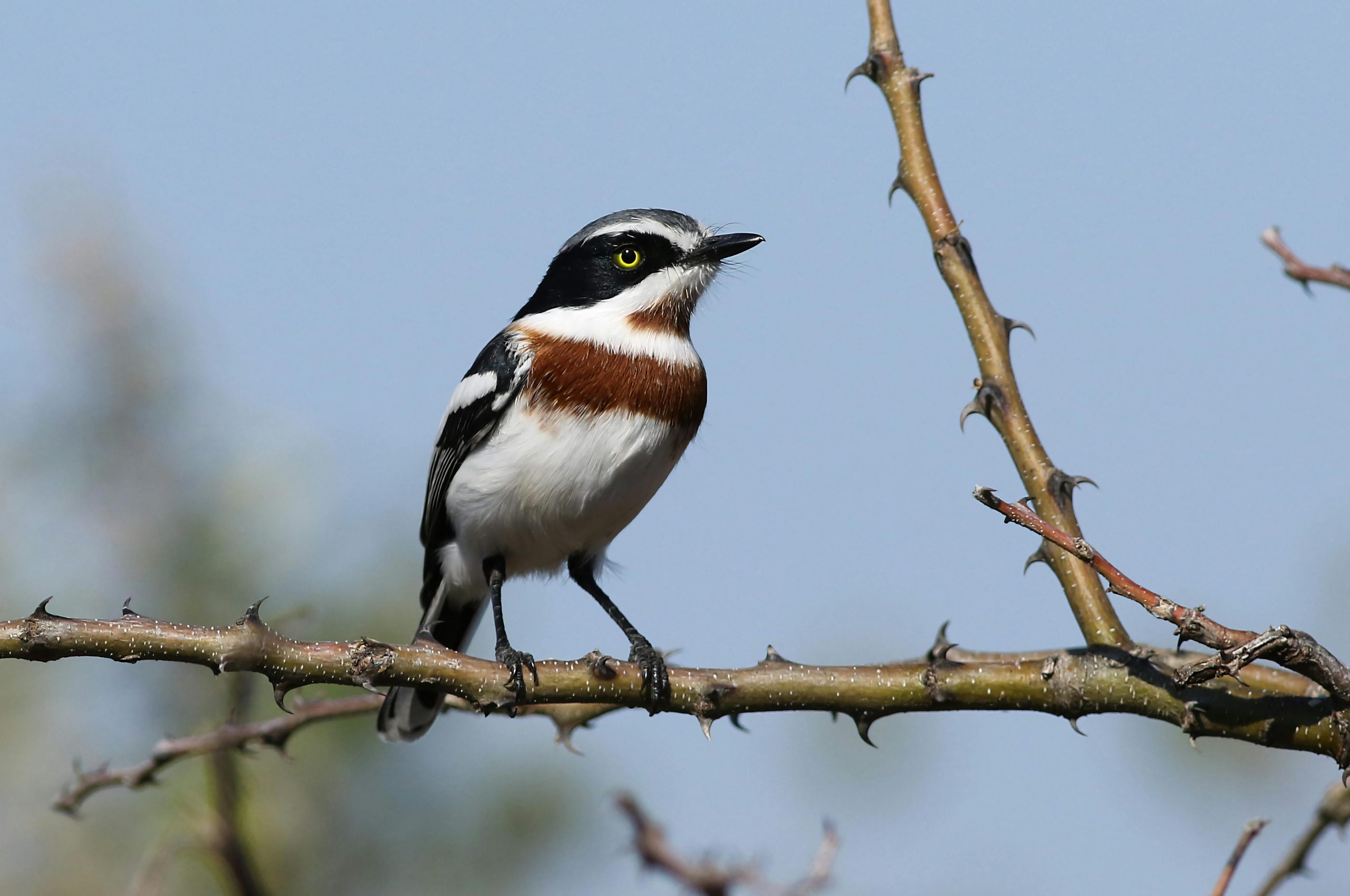
The Rwenzori Batis is a visually captivating bird, measuring approximately 11–13 cm in length. Its plumage is a blend of contrasting colors that make it stand out in its dense forest habitat.
Distinctive Features
- Head: Glossy black crown and face with a striking white supercilium (eyebrow stripe)
- Back and Wings: Slate-grey with black and white wing bars
- Underparts: Clean white belly with a bold black breast band
- Eyes: Bright yellow, giving it a piercing gaze
- Bill and Legs: Short, black bill and dark grey legs
This color pattern not only aids in camouflage among the shadows and dappled light of the forest but also plays a role in mating displays and territorial behavior.
Habitat and Distribution
The Rwenzori Batis is a montane forest specialist, found only in a narrow range within the Albertine Rift—a biodiversity hotspot in Central Africa.
Geographical Range
- Primary Range: Rwenzori Mountains (Uganda and the Democratic Republic of Congo)
- Secondary Locations: Occasionally reported in nearby highland forests such as the Itombwe Massif and Virunga Mountains
Preferred Habitat
- Altitude: 1,800 to 3,000 meters above sea level
- Habitat Type: Moist montane forests, particularly those with dense undergrowth and moss-laden trees
- Microhabitats:
- Forest edges
- Clearings with secondary growth
- Bamboo thickets
This restricted habitat makes the Rwenzori Batis highly susceptible to environmental changes and habitat degradation.
Behavior and Diet
The Rwenzori Batis is an active, agile bird, often seen flitting through the mid-canopy in search of food. It is typically solitary or found in pairs, though it may join mixed-species foraging flocks.
Feeding Habits
- Diet:
- Insects (beetles, caterpillars, flies)
- Spiders
- Occasionally small arthropods
- Foraging Techniques:
- Gleaning from leaves and branches
- Hover-gleaning
- Short aerial sallies (flycatching)
Vocalizations
The bird’s call is a series of high-pitched whistles and trills, often used to maintain contact with mates or assert territorial boundaries.
Breeding and Reproduction
Little is known about the breeding behavior of the Rwenzori Batis due to its elusive nature and remote habitat. However, it is believed to follow similar patterns to other members of the Batis genus.
Reproductive Traits
- Breeding Season: Likely coincides with the rainy season (March–May and September–November)
- Nesting:
- Cup-shaped nests made of moss, lichen, and spider webs
- Typically placed in the fork of a tree branch
- Clutch Size: 2–3 eggs
- Parental Care: Both parents may participate in incubation and feeding
Further field studies are needed to confirm these behaviors and understand their reproductive success rates.
Conservation Status
According to the IUCN Red List, the Rwenzori Batis is currently classified as Least Concern. However, this status may not fully reflect the species’ vulnerability due to its limited range and specialized habitat.
Population Trends
- Estimated Population: Unknown, but believed to be stable in undisturbed habitats
- Distribution: Highly localized, with fragmented populations
Conservation Concerns
- Habitat loss due to agriculture and logging
- Climate change impacting montane ecosystems
- Lack of comprehensive population data
Ecological Importance
The Rwenzori Batis plays a crucial role in maintaining the ecological balance of its forest environment.
Ecosystem Contributions
- Insect Control: Helps regulate insect populations
- Pollination and Seed Dispersal: Indirectly supports these processes by maintaining insect diversity
- Indicator Species: Its presence indicates a healthy, undisturbed montane forest
Protecting this bird means preserving an entire ecosystem that supports countless other species.
Threats and Challenges
Despite its current conservation status, the Rwenzori Batis faces several threats that could jeopardize its future.
Major Threats
- Deforestation: Expansion of agriculture and illegal logging
- Climate Change: Altered rainfall patterns and rising temperatures
- Human Encroachment: Settlement and infrastructure development
- Limited Range: Increases vulnerability to localized disturbances
Conservation Gaps
- Lack of long-term monitoring programs
- Insufficient funding for habitat protection
- Limited awareness among local communities
Conservation Efforts
Several initiatives are underway to protect the Rwenzori Batis and its habitat.
Key Organizations
Conservation Strategies
- Protected Areas: Rwenzori Mountains National Park and Virunga National Park
- Community Engagement: Promoting eco-tourism and sustainable livelihoods
- Research and Monitoring: Conducting field surveys and ecological studies
How to Spot the Rwenzori Batis
For birdwatchers and eco-tourists, spotting the Rwenzori Batis is a rewarding experience.
Best Practices
- Visit During Breeding Season: Increased vocal activity makes them easier to locate
- Hire a Local Guide: Knowledge of specific territories and calls
- Use Binoculars and Field Guides: Essential for identifying subtle plumage details
Recommended Locations
- Rwenzori Mountains National Park (Uganda)
- Virunga National Park (DRC)
- Bwindi Impenetrable Forest (for nearby species)
FAQs
1. What makes the Rwenzori Batis unique among African birds?
The Rwenzori Batis is unique due to its restricted range, striking plumage, and specialized montane forest habitat. It is one of the few bird species endemic to the Albertine Rift, a region known for its high levels of endemism.
2. Is the Rwenzori Batis endangered?
Currently, it is listed as Least Concern by the IUCN, but its limited distribution and habitat specificity make it potentially vulnerable to environmental changes.
3. Can I see the Rwenzori Batis on a birdwatching tour?
Yes, guided tours in the Rwenzori Mountains and Virunga National Park offer opportunities to spot this elusive bird, especially during the breeding season.
4. What does the Rwenzori Batis eat?
Its diet consists mainly of insects such as beetles, flies, and caterpillars, which it catches using agile foraging techniques in the forest canopy.
5. How can I help in conserving the Rwenzori Batis?
You can support conservation by:
- Donating to organizations like BirdLife International
- Participating in eco-tourism
- Raising awareness about the importance of montane forest ecosystems
Conclusion
The Rwenzori Batis is more than just a bird—it is a symbol of the ecological richness and fragility of Central Africa’s montane forests. Its survival hinges on our ability to protect its habitat, understand its behavior, and promote sustainable conservation practices. As we continue to uncover the secrets of this elusive species, one thing remains clear: preserving the Rwenzori Batis means safeguarding a vital piece of Africa’s natural heritage.