
What Primates Can be Seen in Uganda
What Primates Can be Seen in Uganda
What Primates Can Be Seen in Uganda? A Complete Primate Safari Guide
Uganda is one of Africa’s outstanding destinations for primate watching. From the famous mountain gorillas and chimpanzees to colorful monkeys, elusive mangabeys and nocturnal bushbabies, Uganda offers travelers an impressive variety of primate experiences.
Uganda Wildlife Authority highlights chimpanzees and mountain gorillas among the country’s important primate wildlife, while Uganda’s tourism resources identify numerous monkey species occurring across its forests, savannahs and protected areas.
For travelers planning a wildlife holiday, Turkana Wildlife Safaris Uganda can combine primate experiences with traditional game drives, boat trips, bird watching and cultural experiences to create a diverse Uganda safari.
The Main Primates You Can See in Uganda
1. Mountain Gorillas
Mountain gorillas are among Uganda’s most famous primates and are found in Bwindi Impenetrable National Park and Mgahinga Gorilla National Park. Uganda Wildlife Authority confirms these as Uganda’s designated gorilla-tracking destinations.
Gorilla trekking provides an opportunity to walk through the forest with trained guides and observe habituated gorilla families in their natural environment.
A gorilla encounter is particularly memorable because visitors can observe feeding, resting, grooming, playing and communication within a gorilla family.
2. Chimpanzees
Chimpanzees are another major attraction for primate lovers. They are Uganda’s closest living relatives and share approximately 98% of their genes with humans.
The most famous destination for chimpanzee trekking is Kibale National Park, although chimpanzees can also be encountered in places such as Budongo Forest and Kyambura Gorge.
Chimpanzee trekking allows visitors to follow chimpanzee communities through the forest while learning about their behavior, feeding habits and social organization.
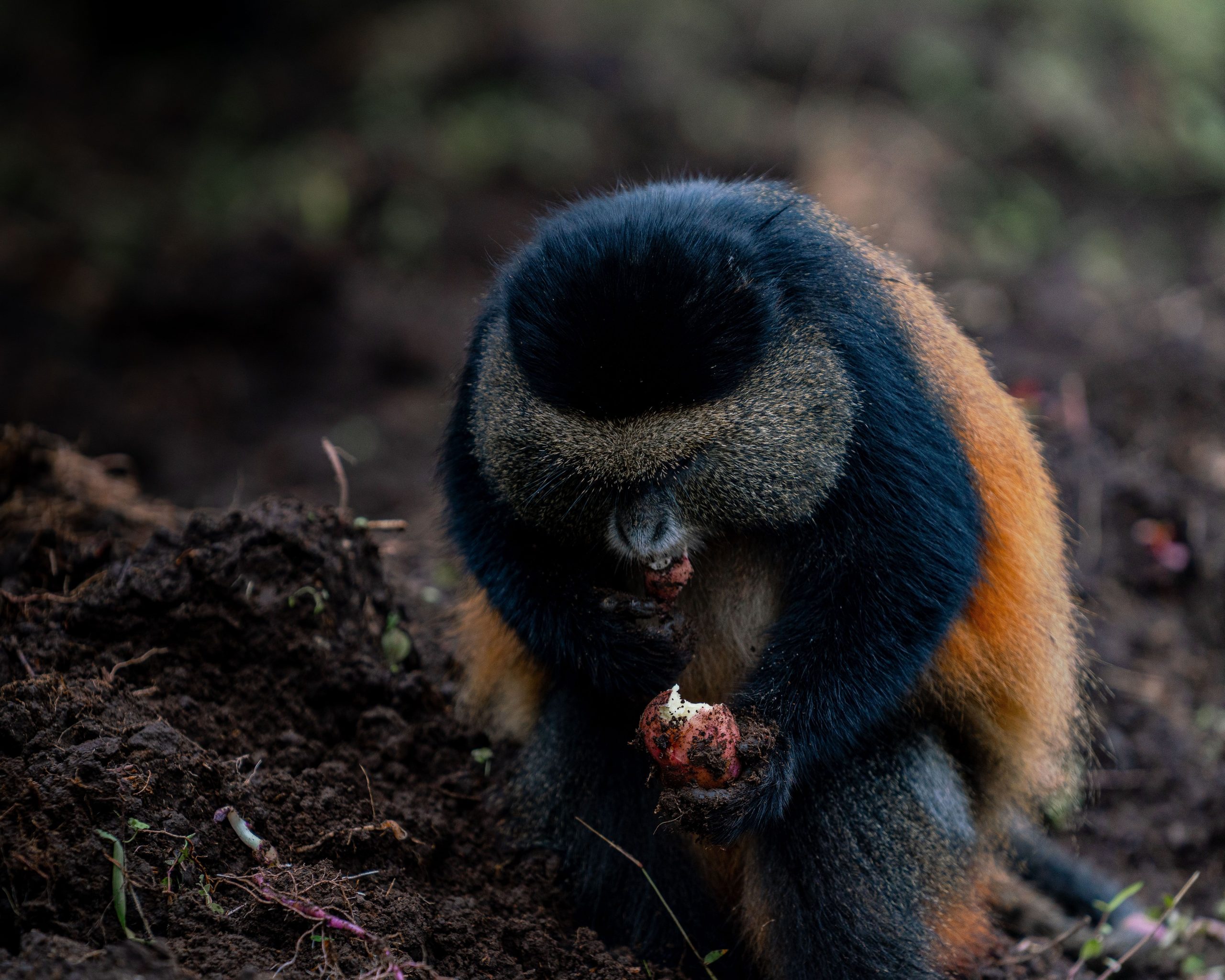
3. Golden Monkeys
Golden monkeys are particularly associated with Mgahinga Gorilla National Park in southwestern Uganda.
Their striking golden-orange coloration makes them one of Uganda’s most distinctive monkeys. They inhabit the bamboo and montane forests of the Virunga region.
Golden monkey trekking can be an excellent addition to a gorilla safari, particularly for travelers who want to experience more than one primate species.
4. Black-and-White Colobus Monkeys
Black-and-white colobus monkeys are among the most recognizable monkeys in Uganda.
Their contrasting black-and-white fur and long, flowing hair make them relatively easy to identify when they are moving through the forest canopy.
They can be encountered in several forest habitats, including Kibale, Bwindi and other protected areas.
5. Red Colobus Monkeys
Uganda is also home to the red colobus monkey, a forest-dwelling primate associated particularly with the Kibale region.
Red colobus monkeys often live in groups and spend much of their time in the canopy. Kibale is an important destination for travelers interested in seeing several monkey species during one forest experience.
6. Red-Tailed Monkeys
Red-tailed monkeys are widespread forest primates that can be identified by their characteristic tail and facial markings.
They occur in places including Kibale, Semuliki, Queen Elizabeth and Bwindi.
They are frequently encountered during forest walks and chimpanzee trekking experiences.
7. Blue Monkeys
Blue monkeys are another forest species found in Uganda.
Despite their name, they do not normally appear bright blue. Their coats are generally grayish or olive-colored, with subtle facial features.
They can occur alongside other guenons, including red-tailed monkeys, making forest walks particularly interesting for primate enthusiasts.
8. L’Hoest’s Monkeys
L’Hoest’s monkeys are less commonly seen than some of Uganda’s more widespread monkeys.
They prefer forest habitats and can be found in areas including Kibale and Bwindi. Tourism Uganda notes that their preference for dense vegetation can make them challenging to spot.
Seeing one can therefore be a rewarding moment during a forest safari.
9. Grey-Cheeked Mangabeys
Grey-cheeked mangabeys are another fascinating forest primate.
They have shaggy grayish-black coats and distinctive pale cheeks. Kibale Forest and Semuliki National Park are among the Ugandan destinations where they can be encountered.
Kibale is especially interesting for travelers who want to see a broad variety of primates rather than focusing on only chimpanzees.
10. De Brazza’s Monkeys
De Brazza’s monkeys are relatively distinctive because of their white beard, facial markings and generally stocky appearance.
They are less frequently encountered than some other Ugandan monkeys and are associated with forest habitats, including areas around Semuliki and Mount Elgon.
11. Vervet Monkeys
Vervet monkeys are widespread and adaptable. They can be encountered in a variety of habitats, including savannah and woodland.
They are active during the day and usually move in groups, making them a familiar sight on some traditional wildlife safaris.
12. Olive Baboons
Olive baboons are among the most widespread primates you can encounter on a Uganda safari.
Unlike forest specialists, baboons are comfortable in open woodland and savannah environments. They can therefore be seen during conventional game drives in several Ugandan parks.
Their social behavior can be particularly entertaining to observe, especially when troops are feeding, grooming or moving across the savannah.
13. Patas Monkeys
For travelers heading into northern Uganda, the patas monkey is an exciting species to look for.
Patas monkeys are adapted to relatively open, dry environments and occur in areas including Murchison Falls National Park and Kidepo Valley National Park.
Their long limbs and reddish coloration distinguish them from many of Uganda’s forest monkeys.
14. Bushbabies
Bushbabies are small nocturnal primates that are rarely encountered during ordinary daytime safaris.
They become active after sunset and are known for their large eyes, excellent night vision and distinctive calls.
Uganda has several bushbaby species, and night forest walks can provide opportunities to look for them. Tourism Uganda notes that Kibale offers guided night experiences where nocturnal primates may be observed.
15. Pottos
Pottos are another nocturnal primate found in Uganda’s forests.
They are slow-moving and highly adapted to life in the trees. Because they are active at night, they are much harder to encounter during normal daytime trekking.
A guided night walk can therefore reveal a completely different side of Uganda’s forest wildlife.
Best Places to See Primates in Uganda
Kibale National Park
Kibale is one of the country’s major destinations for primate experiences.
The park and surrounding forests support chimpanzees and numerous monkey species. A chimpanzee trekking experience can therefore become much more than simply searching for one species.
For travelers particularly interested in primate diversity, Kibale deserves a prominent place on a Uganda itinerary.
Bwindi Impenetrable National Park
Bwindi is internationally famous for mountain gorilla trekking.
The forest also supports several other primates, making it possible to combine gorilla experiences with broader forest wildlife viewing.
Mgahinga Gorilla National Park
Mgahinga is another important destination for mountain gorillas and is especially notable for golden monkeys.
Travelers can therefore combine gorilla trekking and golden monkey experiences in the Virunga landscape.
Queen Elizabeth National Park
Queen Elizabeth National Park offers a combination of savannah wildlife and forest primates.
Chimpanzees can be tracked in Kyambura Gorge, while other primates include black-and-white colobus, vervets and baboons.
This makes Queen Elizabeth particularly useful for travelers who want both classic game viewing and primate encounters.
Murchison Falls National Park
Murchison Falls is primarily famous for its spectacular waterfall and large savannah animals, but the wider ecosystem also provides opportunities to see primates.
Budongo Forest, within the greater Murchison Falls conservation landscape, is particularly important for chimpanzee experiences.
The park’s savannah areas can also provide sightings of baboons and, in suitable areas, patas monkeys.
Semuliki National Park
Semuliki is a fascinating choice for travelers interested in forest biodiversity.
Its primate list includes species such as red-tailed monkeys, blue monkeys, grey-cheeked mangabeys and other forest primates.
Gorilla Trekking vs Chimpanzee Trekking in Uganda
Both experiences offer unforgettable encounters, but they are quite different.
Gorilla trekking focuses on finding habituated mountain gorilla families in mountainous forest terrain. The experience is generally slower and centered around observing family behavior.
Chimpanzee trekking involves following mobile chimpanzee communities through the forest. Chimpanzees can travel quickly through trees and across the forest floor, creating a more dynamic tracking experience.
Uganda Wildlife Authority officially recognizes both gorilla and chimpanzee tracking as visitor activities and has established guidelines for their management.
Why Choose a Primate Safari in Uganda?
A Uganda safari can provide an unusual combination of experiences.
In one trip, travelers can potentially:
- Trek mountain gorillas.
- Track chimpanzees.
- Search for golden monkeys.
- See black-and-white colobus monkeys.
- Watch red-tailed and blue monkeys.
- Look for mangabeys and L’Hoest’s monkeys.
- Search for nocturnal bushbabies and pottos.
- Combine forest trekking with savannah game drives.
- Enjoy boat trips and bird watching.
- Experience local communities and cultures.
This variety makes Uganda particularly attractive to travelers who want a safari that goes beyond traditional big-game viewing.
Planning a Primate Safari with Turkana Wildlife Safaris Uganda
Turkana Wildlife Safaris Uganda can help travelers build an itinerary around their preferred primate experiences.
For example, a safari could combine Kibale chimpanzee trekking with Queen Elizabeth National Park for wildlife viewing, followed by Bwindi for mountain gorilla trekking.
Another itinerary could combine Mgahinga golden monkey trekking and gorilla trekking, while travelers interested in a broader wildlife experience could add Murchison Falls, Queen Elizabeth or Kidepo Valley National Park.
The ideal itinerary depends on the species you want to see, the number of days available, your preferred activities and the type of accommodation you want.
Frequently Asked Questions About Primates in Uganda
1. How many primate species are found in Uganda?
Uganda supports a wide variety of primates, including great apes, monkeys and nocturnal primates. Uganda Wildlife Authority describes the country as home to 13 types of primates, while broader species lists and tourism resources document additional primate diversity depending on classification and species coverage.
2. What is the most famous primate in Uganda?
Mountain gorillas are among Uganda’s most famous primates, followed closely by chimpanzees and golden monkeys.
3. Where is the best place to see chimpanzees in Uganda?
Kibale National Park is one of Uganda’s principal chimpanzee trekking destinations. Other opportunities exist in forests such as Budongo and Kyambura Gorge.
4. Where can I see mountain gorillas in Uganda?
Mountain gorillas are found in Bwindi Impenetrable National Park and Mgahinga Gorilla National Park.
5. Where can I see golden monkeys?
Mgahinga Gorilla National Park is Uganda’s key destination for golden monkey experiences.
6. Can I see monkeys during a Uganda safari?
Yes. Depending on the destination, travelers can encounter colobus monkeys, blue monkeys, red-tailed monkeys, vervets, baboons, mangabeys, L’Hoest’s monkeys and other species.
7. Can I see primates at night?
Yes. Guided night walks can provide opportunities to search for nocturnal species such as bushbabies and pottos.
8. Are chimpanzees dangerous?
Wild chimpanzees should always be treated as wild animals. Visitors should follow their guide’s instructions, maintain the required distance and avoid attempting to touch or feed them.
9. Can I combine gorilla and chimpanzee trekking?
Yes. Many Uganda itineraries combine Kibale with Bwindi or Mgahinga, creating an excellent great-ape-focused safari.
10. What is the best time for a primate safari in Uganda?
Uganda’s primate destinations can be visited throughout the year. However, travelers should consider seasonal rainfall, trekking conditions and their preferred activities when choosing travel dates.
11. Is Uganda good for a family wildlife safari with primates?
It can be, although age requirements and activity-specific regulations apply to trekking experiences. Families should check current Uganda Wildlife Authority rules when planning gorilla or chimpanzee activities.
12. How can I book a primate safari in Uganda?
Travelers can work with Turkana Wildlife Safaris Uganda to design a safari around chimpanzees, gorillas, golden monkeys and other primates, combined with Uganda’s other wildlife and cultural attractions.
Conclusion
Uganda offers an exceptional variety of primate experiences, ranging from mountain gorillas and chimpanzees to golden monkeys, colobus monkeys, mangabeys, vervets, baboons, patas monkeys, bushbabies and pottos.
Kibale is particularly important for chimpanzees and forest primate diversity, Bwindi and Mgahinga are central to gorilla experiences, while Queen Elizabeth, Murchison Falls and Semuliki provide additional opportunities to encounter Uganda’s remarkable primate wildlife.
For travelers who want to experience Uganda beyond the traditional Big Five safari, a primate-focused journey with Turkana Wildlife Safaris Uganda can combine forest trekking, chimpanzee and gorilla encounters, golden monkey experiences, game drives, boat safaris and cultural activities into one memorable adventure.